Skip to content
Greg Fok Advisory
  • Services
  • Blog
  • Speaker
    • For Advisors
    • For Clients
  • Testimonials
  • Questions
  • About Us
    • Gregory Fok
    • Joy Koh
  • Contact Us
Investments

What is the average investor returns?

  • June 12, 2019June 12, 2019
  • by Gregory Fok

What is the average investor returns?

I was in a conversation with a ex remisier..

He had been investing for the past 15yrs and has gotten no where when it comes to his investments.

He tried all kinds of investments, stocks, options funds and even forex.

His verdict:
I made lots of money. I also lost lots of money. After the very volatile 15yrs of his life, investing by himself gets him nowhere close to his goals.

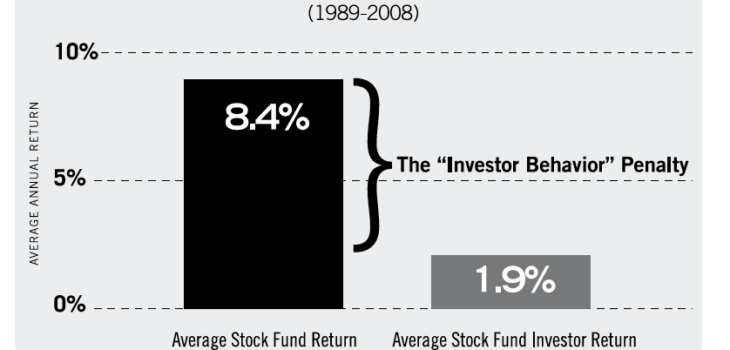
There is a study done that shows that average investors tend to underperform the market, largely due to one main reason – irrational human behaviour when it comes to investing which is multi faceted.

The human mind is designed not to make good decisions when it comes to investing. And that is the main reason for the huge gaps between the average investor and the actual market returns.

For those who have experienced it before and know about it, they will fall into various different traps from an emotional perspective.

There are 9 factors that cause an average investor to invest poorly.

If you would like to find out more, let me know and we can connect.

Speak with your experienced advisor so that you are confident of investing for the future.

Photo credits : Dalbar

Insurance

Tip #1 Financial Planning Advice

  • April 30, 2019April 30, 2019
  • by Gregory Fok


Be clear of your financial objectives.

We all know this feeling. Money is flowing in all directions and there is always something that comes up which is a priority.

When it comes to financial planning, there are multiple objectives as well. We need to save for retirement. We need to get the insurance. We need to pay the mortgage. We need to send our kids to university. We need to invest our money…. and the list goes on.

If you are not clear of your priorities in life, you will keep shifting your priorities and along the way, lose money and you say that financial planning does not work.

You just need to get it right from the start of what you want to do and why you need to do it and stay focused.

The truth is – this is probably the hardest part of the planning.

Business

Successful Businessman thoughts

  • March 28, 2019March 28, 2019
  • by Gregory Fok

If Mr. Businessman has four basic objectives, then there are four questions that should be asked:

  1. What is the price tag on the first clause in his will, which says, “Pay my debts, taxes and costs?”
  2. Who will write a check each month to his family, and for how long?
  3. How will the assets be transferred to the children one day with minimal conflict?
  4. How can the business be kept healthy?
Business

The larger the assets, the larger the potential problems

  • March 6, 2019March 6, 2019
  • by Gregory Fok

The larger the assets, the larger the potential problems.

We have experienced going through some tough times with the people we work with especially when the person passes on.

Most of the assets that is being held is not liquid. Some examples of assets that are not liquid are properties and businesses.

And normally, these are converted to cash at the worst price and time in order to split the properties. And businesses are closed after many years of operations because the owner did not look into the details of succession.

And that is where you normally see the stories on the newspapers where the children and partners are trying to have a fair settlement over the assets, which usually does not turn out pretty.

The wealthier and senior a person gets, the more they have accumulated and the bigger the problem becomes.

If you know of a successful person or business owner with significant assets in the age range of between 40 to 65, highlight these potential risks to them.

Business

2019 Financial Advice

  • January 16, 2019January 16, 2019
  • by Gregory Fok

2019 financial advice

A number of people have been asking me for advice for this coming year and what to do with their money.

I go back down to the fundamentals.

1) Spend less than what you earn.
Set a budget for your expenditure and keep within it.

2) Create an emergency fund of minimum of 6 months.
You never know what is going to break down or go wrong.

3) Plan for the long range goals like retirement, insurance, estate planning.
The earlier you start planning, the easier it gets for you and your family.

4) Debt reduction
Avoid rolling over credit card debt at all costs! Clear off credit card loans every month. The only loan you should try to have left is your home loan as it is usually the largest.

Insurance

7 figure payout

  • November 20, 2018
  • by Gregory Fok

7 figure payout!

Is insurance an investment asset class?

Recently, I was helping a friend with his will. His biggest concern is not to leave any debts or liabilities for his wife and children.

When we looked at the breakdown of his assets, initially, it seemed like there was not much to begin with.

Very soon, we realized that there is a large pay out of more than 7 figures when he is no longer around. And 95% of his portfolio is from insurance that we had helped design for him since about 10yrs ago.

Then he heaved a sigh of relief and in fact, started to smile as he had ensured that his family does not need to worry.

Insurance is an asset class which is typically forgotten and ignored until the unexpected event happens. No matter how bad the markets are or bad the timing is, insurance payouts will eventually happen and we have seen that in our 13 years of practice. Insurance is the cheapest form of asset class if you know how to structure it.

Have you designed your 7 figure payout? How did he do it? If you would like to find out more, speak to us, your trusted financial advisor from Steward of Wealth to value add to you.

#7figurepayout

Investments

How to buy low and sell high

  • October 1, 2018
  • by Gregory Fok

How do you buy low and sell high?

One of the most difficult strategies to implement in investments is to buy low and sell high.

In a roaring market, no one likes to be left behind and have to take on less risk.
In a bearish market, everyone is fearful that it might just get even worst so people hold on at the side lines.

We put a system in our wealth management strategy to consistently rebalance at particular points irregardless of market conditions.

Rebalancing helps us to take the emotions of investing away and make very rational and logical decisions. And that is to buy lower and sell higher.

Speak with us to take the emotions away from systematic investing.

https://www.bloomberg.com/view/articles/2018-09-27/no-taper-tantrum-here-emerging-markets-look-like-a-haven

Investments

Investing in a volatile market

  • September 20, 2018September 20, 2018
  • by Gregory Fok

What to do when markets are volatile?

How are you feeling?

With the backdrop of the increased volatility in the markets, it can be
unnerving to be seeing your portfolio too frequently. There is going to be
a US-china talks held on the 21-22nd Aug in the United States, to speak on
the tariffs.

Not much might change, as both sides are still going strong with their
views but it seems that both countries eventually want to achieve a win
win situation.

It is also time to bring you back to the
fundamentals of investing.

1) Time is your friend
Speculators who have short time horizons will be very fearful at this point because of uncertainty. Long term investors will be happy because it
can be good time to buy in when markets are discounted right now. You get
to buy more when markets are cheaper.

2) Stick to your original objectives
Do not shift your long goals just because markets have shifted in value.
In fact, any downward shift is good for long term investors.

3) Do not let emotions take over.
Back in 2008, there was extreme fear in the markets especially when
markets collapsed unexpectedly. However, if a person stayed the course
of investing and topped up, he would have emerged much better off today
than 10years ago.

4) diversify
In volatile markets, single companies could collapse and never recover. In a portfolio of diversified investments, continuing to buy in a downtrend market is fine.

A 100% equity allocation like China would have dropped by about 25% by
now, but because we are widely diversified in a portfolio, we are still
affected, but slightly affected, down in the range of 5-6%.

In short, what should you do now?
a) Stay calm and relax, drink your coffee.
b) Stay invested and TOP-UP if you have extra money meant for the long
term now.
c) Continue to rebalance regularly.

Business

Create legacy and retirement strategies

  • September 13, 2018September 13, 2018
  • by Gregory Fok

Create legacy and retirement strategies

You are now a successful business owner or individual and have built more than sufficient for yourself. But you are worried about your children and if they might be able to manage.

One of the strategies we use is to create legacies for 3 generations.

With an structure of an annuity, you start off by benefiting through the monthly payout it provides to yourself as the contributor. You are the first generation.

As you pass on, the funds continue to last for the period of your children’s lifetime. It means that the monthly payout continues for the rest of your child’s life. If he lives till age 100, the payout continues till then.
And when he passes on, there’ll be a death benefit that would be paid out to the 3rd generation, which is your grandchild.

On top of that, with an annuity trust, you can ensure that the funds are protected from divorce or even bankruptcies of your children and grandchildren. In this way, the wealth will be protected from unnecessary risks.

Investments

What type of investor are you?

  • August 6, 2018
  • by Gregory Fok

Which type of investor are you?

Through my 13 years of investment experience, I have concluded that there are typically 3 types of investors.

Category 1
This is a very hands-on investor. They do all the research in the companies and markets by themselves. They have absolute interest and time to invest. They love to have full control of their investments and they know how to control their emotions when markets swing even as fear and greed sets in. They’re exactly able to invest like Warren Buffet. Only 1% of the world’s population will be in this category. They know exactly what strategies to adopt when market conditions turn either ways. However, this group have large blindspots which they never think about in protecting their assets when health changes. Transferring wealth with minimal complications are hardly thought about since they are very investment focused which might cause future problems down the road. The biggest downfall for this group of investors is that they assume they know it all.

Category 2
This is a combination of a full hands-on and hands-off investor. Whilst they want to have some control, they know they do not know have all the answers. Some start off as category 1 investors and after 5-10years of investing by themselves, they realize they are not getting anywhere. This is when they turn to some professional help.
They have some interest and some time but identify that they may not be able to manage it all by themselves especially when markets swing. Amateur investors who try it by themselves end up badly burnt and never want to enter the markets again or they do investments based on managed risks. They might need some help but have no trusted source to turn to. This group of people want to be able to journey with a trusted advisor to help them to clarify their decision making. They are also willing to pay fees to seek help because they have gone through the pain of trying out on their own.

Category 3
This is a hands off investor. They do not have the time or interest when it comes to investments. So they will not have any interest in researching or reading up. This group just live their lives on a month to month basis and it is paycheck to paycheck. They are stuck in a rat race and have no solutions to do something about it. They might have a desire to change their lives but the mundane life takes over and they only wish for a better way out. They hope and rely heavily on the government to help them out.

Which type of investor are you? If you are the category 2 type of investor, be open and have a chat with an experienced financial advisor who can journey and guide you through the ups and downs of life.

Posts pagination

1 … 10 11 12 13
Copyright © Greg Fok Advisory
Theme by Colorlib Powered by WordPress