Skip to content
Greg Fok Advisory
  • Services
  • Blog
  • Speaker
    • For Advisors
    • For Clients
  • Testimonials
  • Questions
  • About Us
    • Gregory Fok
    • Joy Koh
  • Contact Us

Should I be my own doctor?

  • June 15, 2020June 15, 2020
  • by Gregory Fok

If you had an option, you could go to a part time junior doctor under going training and ask him to do a surgery on you.

Or you could go to a trusted experienced surgeon who has seen 1000s of patients and have been doing this for the past 15yrs and could immediately understand your problem, get a diagnosis and help you to draft a treatment plan.

Which will you prefer?

When it comes to family wealth planning and investing, you might unknowingly be doing the same.

We have seen consumers trying to DIY. They take an approach where they try to read the markets, trends, study companies and grow their wealth, protect their income, family and do all this part time whilst they are busy working in their main job.

At best, after all your effort you put in as a consumer, you become a part time surgeon with minimal experience to speak of.

Would you be confident to allow yourself to be operated by this part time surgeon, who does not have enough experience seeing enough patients to operate on you?

If you do not, please instead spend time to interview and look for a trusted advisor whom you can journey with on the long term and provide holistic financial advice.

It saves you lots of time, money and emotional pain. All that time and energy can be then converted to spend time with your loved ones and fill it up with your passions in life that are important to you.

Go and spend your time to live a life of possibilities!

Common overlooked fact by doctors

  • June 10, 2020June 10, 2020
  • by Gregory Fok

As doctors, you spend most of your time focusing on your craft as a medical specialist..

Your work demands long hours and you even sometimes have to skip meals. We specialize in working with doctors so we understand what you go through. All your time is spent either working or studying with hardly any time left. If you get married and have kids young, it accelerates the sleep deprivation cycle.

Time passes so quickly and by the time you get a little more control on your life, you are probably about almost 40 years old. That is the main reason why most doctors might eventually decide to move to private clinics or set up their own medical practice before the control happens.

Whilst the busyness of life takes over, health deteriorates and some doctors might get hit with the same medical conditions that they were treating the patients for.

When that happens, the income flow suddenly stops.. Life is affected, work is affected, income is affected, but expenses of the house mortgage, the car, the family continue. If you have your own clinic, you still got to pay rental, pay for equipment, pay for staff salary and the list goes on…

What if you took a few minutes every year just to review your overall financial situation and ensure that your income can be intact and even have a sinking fund that can tide you and your family over the next 10-20yrs without a need to worry when bad things happens?

Wouldn’t that few minutes of that precious conversation allow you to have more financial freedom and protection?

We specialize in working with doctors and know what you go through. Let us have an initial chat.

Shall we pick the winners ever year

  • May 28, 2020May 28, 2020
  • by Gregory Fok

So often, we have tried to outperform the market by doing our homework and trying to decide where the next winner will be for every year.

Picking the winners

It reminds me of the time many years ago, when I tried to pick out the stocks as winners every year to get my hard earned savings to work harder. And after investing for about 10years or so, I realized that I could make 7 right decisions out of 10 companies, which probably is quite good, if you ask most seasoned investors out there. But all it took was one wrong move and that could wipe out all the other good decisions made through the past 10years.

Mental cap

One top of that, when investing into stocks, there was a mental cap of how much I will be willing to invest into that company. Everyone has that mental cap. You will know it yourself. When it became too much for comfort, I stopped investing and the amount just hovers around that region for many years and when market risks increased, the emotional roller coasters take over and wrong decisions are usually made. If I believe so much in the company, I should be adding on even more when companies are at a cheap. But the haunt of Kodak, AIG, Hyflux and SIA keep coming back and we know not all companies last at a previous price forever.

Buying low and selling high

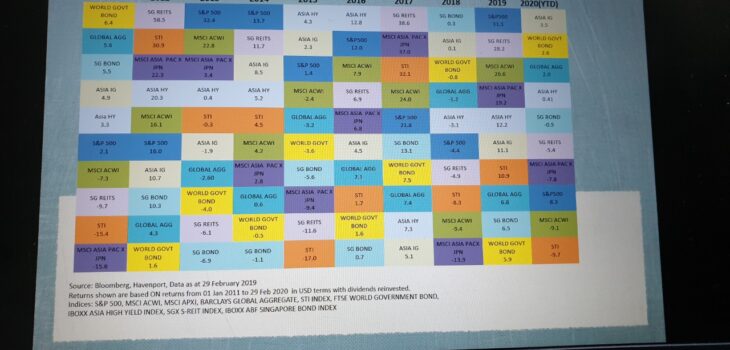
It does not help with the need to make educated decisions of what to sell and who to sell when markets were soaring and which to buy in the rotation during different times of volatility. Again, this time is different is a mantra that most stock holders find difficult to understand at various periods. If you just look at the chart above, you will see that every year, different asset classes hold the pole position. It’s almost an impossible job to do to ensure that you get it right every year!

Change needed for better results and lower risks

I knew about 5 years ago that change was needed and I adopted a different approach which could relieve me of the emotional roller coaster, save me lots of time so that I can spend it on my career and family, allow me to confidently add on aggressively during a downturn without worrying about companies collapsing in front of me. With the change, I built up about 5x of investments what I used to have in my previous strategy, in half the time.

Coming back to the question, can we pick the right winners every year? If you are a seasoned investor, you know what the answer is.

If you want peace of mind with more time on hand to do things you love, why shouldn’t you have an initial chat with us to see if there is a right fit.

Our brain is wired to lose money!

  • May 14, 2020July 13, 2020
  • by Gregory Fok

Do you know that our mind and brain is designed to lose money?

Imagine this with me. You are walking happily along the streets and suddenly, in front of you, there is a huge explosion! What is your first response? Is it to stand up and run towards the explosion? Or to duck down and run away from the explosion?

The amygdala or “the alarm” part of our brain reacts to fear, danger and real or perceived threats. It was designed to protect us from threats and regulates our emotional state.

Likewise, in a market crisis and stocks are falling, your brain’s initial response is to avoid the markets. This is called behavioural finance and our natural response to market crisis.

There was a survey done on participants with damaged amygdala who were invested during a market crisis. In fact, they were able to make better decisions when it came to investing before, during and after the crisis.

In short, our human brain is not designed to help us be successful in investing.

There are seasoned investors who have invested for many years and when the amount gets very large and the market falls are significant in the later years, wrong decisions are being made at the worst of times.

However, when you have a gatekeeper to keep your emotions in check, whilst trying to achieve your own long term personal goals, this helps to minimize the likelihood of emotional decision making. We are here as licensed financial advisors, who are gatekeepers for your wealth to ensure that you make sound decisions that do not detract you from your personal goals. On top of that, we help you make great decisions in times of crisis to build you further propel you towards your goals.

Measuring the distance

  • March 21, 2020March 21, 2020
  • by Gregory Fok

With the volatility in the market, it can be very scary and unnerving at the same time.
This also leads to potentially making emotionally charged decisions – which leads to decisions based on fear or greed. That normally leads to regrets further down the road on hindsight.

The important thing to do now is to focus on your goals.
For example, if I asked you to measure the distance between Changi Airport to Jurong Point, would you take a measuring tape and stop to measure every 3 steps before you reach Jurong point? Or would you use a vehicle, chart the starting point and end point and move towards your goal. Maybe you might stop to check every 5km to see if there is a faster route available, but definitely, you do not need to check every 3 steps.

It’s the same when it comes to retirement planning. Most of the time, we invest because we have a long-term goal like retirement which is a far distance away. So it does not make sense to keep checking our investments every other day. Whenever we check it, it might just lead to stress and emotions of greed and fear take over.

At the same time, there will be opportunities for a faster way to get to your retirement. This will be one of them and you might just miss out the “Sale” that comes a few times in your lifetime. This kind of sale of this magnitude will not come very often but it will be the road less travelled.

So here are a few tips.


1) Focus on your long-term goals and not get distracted.

2) If you have extra cash over and above your 6-12 months emergency funds, you can find strategies to deploy this money during this opportunity.

3) Find risk and non-risk instruments to give you peace of mind.

4) Invest into Global CORE portfolios that are rebalanced by professionals so that you do not need to stress about doing that on your own and after you invest during this period.

5) Do NOT peek at your statements if you are already invested or going to be investing this period.

6) Finally, pls do not read the news too much. It can be mostly depressing because bad news sells. Instead, spend more time with your family and do things you love and go out into the sun more often.

If you have a doctor, business owner or senior management whom is trying to get an opinion from their wealth advisor and is not able to do so, I will be happy to connect with an initial chat.

Correction and bear markets – good or bad?

  • February 26, 2020February 26, 2020
  • by Gregory Fok

A correction normally refers to a drop of at least 10% in the price of a stock (or stock market) from a recent high. 

A recent movement in the market has sparked some huge responses in the past 2 days and it would be interesting to note that speculators tend to flee the market while long term investors start to take this as an opportunity. Here’s an explanation of the difference between a correction and a bear market.

A correction is different from a bear market as the bear market is defined as a fall of 20% or more from a stock market’s most recent high.

Corrections and bear markets may sound terrifying, but we shouldn’t fear them as they are common features of a healthy stock market. They are usually short-lived too.

According to Fidelity, since 1920, the US’ S&P 500 index has experienced on average a pullback (defined as a brief 5% reversal in the price of an asset) 3 times a year, a correction once a year, and a bear market every 3 years.

For those investors with a long-term view of the stock market, corrections and bear markets provide great opportunities to buy stocks in wonderful companies at lowered valuations.

Is this a good time to invest?

  • February 17, 2020February 17, 2020
  • by Gregory Fok

Is this a good time to invest?


Wherever there is crisis in the economy, the question comes up more often than ever.


And during the past month, this has been a common question that came up so I thought to pen my thoughts down..


I had a doctor friend who was recommended to speak to me after he exited the market when Singapore turned DOSCORN Orange and realized his losses because there was so much fear on that day. Herd instincts took over Singapore by storm at the supermarkets just like how it had taken over in the stock markets. My friend figured that I could possibly help him better.


Inexperienced investors can be caught on the wrong side of the coin at that time.


Traders and analysts are trying to predict the trend in the markets of what will pen out over the next 6-12 months, but how many actually get it right? Let’s go back a bit in history. During the 2018 US-china trade war, everyone thought that 2019 will be a washout year, instead it turned out to be one of the better years of investing. And investors who stayed on the sidelines would have missed out on that massive gain of almost 20% in 2019 in a total PORTFOLIO.


The important thing to note is that markets are always forward looking and they would have priced in the forecasts of the markets ahead of time as well.


Anyone who tries to tell you where the markets are heading are mostly making guesses. The honest answer to the title would be that it is impossible to know where the markets will turn on the road ahead given that the markets are also driven by emotional sentiments and mostly not by logic.


With the current growing concerns of the COVID 19, supply chains would be severely disrupted. Those countries that rely heavily on international trade and tourism like Singapore, would be a huge cause of concern. However, just like SARS, H1N1 and the other flu like outbreaks we had in the past 2 decades, over time, life will eventually go back to normal and that is when markets will float back up again.


So since it is almost impossible to predict which countries or economies will go up and down, we believe a well-diversified portfolio across the entire world (US, Asia, Europe, emerging markets) with a good mix of asset allocations that fit your risk profile would be best suited to invest for the long term. Ensure that there is active rebalancing done as well, so that you do not hold on to losses nor get too excited with significant gains. Rebalancing helps to create a smoothening effect to your portfolio.


In fact, any pull backs in the markets present buying opportunities for LONG term investors.


Go back to the basics of planning of patience, prudence, discipline and pray before you make a decision and work with an experienced advisor who has gone through multiple crisis and you will eventually turn out better over the long term.

Should a doctor invest in stocks or his/her own…

  • January 20, 2020January 20, 2020
  • by Gregory Fok

I have met some doctors recently with insightful conversations.

There was this doctor who was proud to mention he made 10% on his
investments on a long term basis. It worked out to be about $10,000 from his principal of $100,000 put aside for stocks.
And that would include the emotional swings in the
company stock prices and decisions to make, which he shared that it took time to track and monitor
which sometimes gave him a “heart attack” especially in 2018.

Based on his overall portfolio of cash around $500,000, if you do a total
portfolio calculation, it would actually work out to be less than 2%!

I gave him 2 suggestions..


1) Invest time into his practice. By focusing on career, he could easily have generated more than $10,000 over the years.

2) Pay someone to create a CORE portfolio with a worldwide objective,
constantly managed and rebalanced to keep your risks in check. This
eliminates risks of specific companies and markets and with a diversified
portfolio, with less volatility and reasonable returns which easily can be
more than $10,000. And this offers a peace of mind which moves the
portfolio within a range of comfort for the individual.

Does it still make sense to invest into property?

  • December 30, 2019February 16, 2020
  • by Gregory Fok

Does it still make sense to invest in property today?

Some factors have changed today’s environment.

Stamp duties, including ABSD

Hefty stamp duties to the government are laid out right at the beginning of the purchase of the property. Depending on the number of properties, it can be as high as about 20%.

Tax

Properties attract tax over the income and the property tax that needs to be paid. This is usually glossed over and ignored.

Potential growth value

Due to the government measures, the rate of growth will be different in order to keep housing still relatively affordable.

Rental income

The yield for rental income has been dropping over the years with a larger supply of units.

Macro environment

There’s an addition of housing supply of another 30,000+ units in the market in Singapore. Developers are also looking outside Singapore due to the increased risks.

Property is still an instrument that is needed for people to stay and live in.

    However, if a person would like to invest, there are numerous other instruments that can potentially do the same or better in the longer term with reduced costs and risks.

    What is the average investor returns?

    • June 12, 2019June 12, 2019
    • by Gregory Fok

    What is the average investor returns?

    I was in a conversation with a ex remisier..

    He had been investing for the past 15yrs and has gotten no where when it comes to his investments.

    He tried all kinds of investments, stocks, options funds and even forex.

    His verdict:
    I made lots of money. I also lost lots of money. After the very volatile 15yrs of his life, investing by himself gets him nowhere close to his goals.

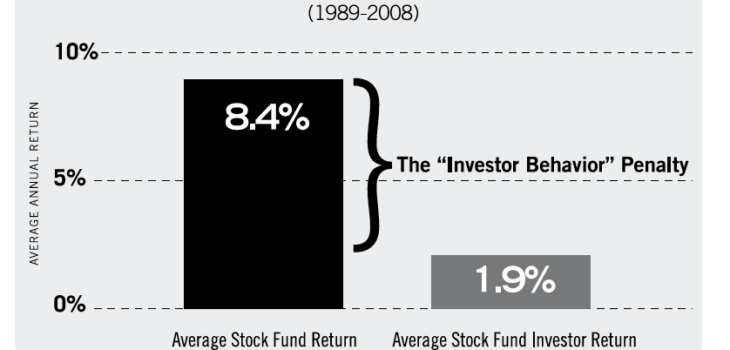
    There is a study done that shows that average investors tend to underperform the market, largely due to one main reason – irrational human behaviour when it comes to investing which is multi faceted.

    The human mind is designed not to make good decisions when it comes to investing. And that is the main reason for the huge gaps between the average investor and the actual market returns.

    For those who have experienced it before and know about it, they will fall into various different traps from an emotional perspective.

    There are 9 factors that cause an average investor to invest poorly.

    If you would like to find out more, let me know and we can connect.

    Speak with your experienced advisor so that you are confident of investing for the future.

    Photo credits : Dalbar

    Posts pagination

    1 … 3 4 5 6
    Copyright © Greg Fok Advisory
    Theme by Colorlib Powered by WordPress